There is a great post over at the Newton Blog on RealClearScience about Nobel laureate Norman Borlaug, the agronomist who was the Father of the Green Revolution. It demonstrates the difference between the Green Revolution and Green Imperialism. Starting in Mexico, he toiled “for endless hours in the lab and in the fields to breed a wheat plant that was resistant to disease, thick-stemmed, and enormously productive.” Mexico’s wheat yield was six times higher in 1963, sixteen years after Borlaug’s arrival. Ninety-five percent of Mexico’s wheat was of “Borlaug’s dwarf variety.” Developing nations began sowing Borlaug’s crop. The results? “Global yields skyrocketed. Starvation rates decreased. Doom was postponed.”
Yet, environmental lobbyists attempted to block Borlaug’s expansion into Africa. They even convinced the World Bank, the Ford Foundation, and the Rockefeller Foundation to cut funding. While Borlaug was able to boost Ethiopia’s wheat yield to record levels, Africa is still steeped in starvation.
“Some of the environmental lobbyists of the Western nations are the salt of the earth, but many of them are elitists…” he told The Atlantic. “If they lived just one month amid the misery of the developing world, as I have for fifty years, they’d be crying out for tractors and fertilizer and irrigation canals and be outraged that fashionable elitists back home were trying to deny them these things.”
But the post doesn’t stop there. It captures perfectly what is often wrong with environmental debates:
As with most debates, this one comes down to intrinsic values. From our lofty position in the developed world, we have the luxury to value the fallacious image of pristine, untouched nature over feeding ourselves. Hunger simply isn’t something that most of us are familiar with.
“These people have never been around hungry people,” Borlaug says of people like this. “They’re Utopians. They sit and philosophize. They don’t live in the real world.”
Proselytizing is easy. But try doing it when you’re starving.
Walker recently posted on a study showing that 19th century missionary efforts had a positive, even vital effect on the development of liberal democracy.
The study focused on “conversionary Protestants,” but if we look beyond the scope of democracy, we still find that the influence of missionary group was by large a positive one. This includes ”non-conversionary” Protestants, Catholics, and Orthodox. Some interesting examples come from missionary efforts in 19th century Palestine, and they have something to tell us about the supposed dichotomy between science and religion, as well as the contention that religion is a corrosive, negative influence.
Missionary movements have made a very real contribution to the spread of modern medicine. As an example (though certainly not the earliest), for over half a century one of the few modern hospitals in Israel/Palestine was the one run by Scottish missionaries in Tiberias, by the shores of the Sea of Galilee. In 1885, the young Dr. David Watt Torrance arrived as a medical missionary. His clinic was at first very small- only two rooms- and the locals were understandably suspicious of his motives. Torrance gained the confidence of the locals due to his skill and compassion, although very few took any steps toward conversion. In 1894, a proper hospital was built, and it remained in operation until 1959. Malaria and dysentery were among the most common illnesses treated at the hospital.
To give an idea of just why this was a big deal, before the medical missionary efforts traditional medicine in Palestine involved amulets, pilgrimages to the tombs of holy men, exorcisms, and bloodletting. This was true no matter to what religion or social class you belonged.
One measure of these medical missions’ success was that Jewish communities in turn made increased efforts to establish their own hospitals and clinics wherever missionaries operated as a way to counter their influence.
It is probably not an exaggeration to say that tens of thousands owe their lives to the Torrances’ religion (Herbert took over from his father until his own retirement in 1953), and the number increases significantly if one takes other mission hospitals into consideration. Torrance himself paid a terrible price- he buried two wives and four children in Tiberias. It was Torrance‘s faith in God which led him to dedicate his life to improving the health and lives of Galileans, regardless of their religious denomination or convictions. Science, that is, modern medicine, was his tool, but religious faith was the motivator. What the Torrances and other medical missionaries show is that religion has often led to the spread of science in very practical ways.
We suggest that it is informative to emphasize a new dimension to the study of missions- that of the relationship between religion and belief systems and place or space. Within the missionary context this relates to the study of the impact of missionary concepts and activity on environmental and spatial change and the creation of new urban and rural landscapes. These reflect far-reaching effects that remain evident to the present.
Their study deals with two German missionary groups. The first, Protestants, founded an orphanage and school in 1860 just outside of Jerusalem for Christian victims of persecutions in Lebanon. Not only did they provide schooling, they also taught the children various practical trades employing and constantly upgrading modern methods of production.
In 1889, German Catholic missionaries purchased land at Tabgha, the traditional site of the Miracle of the Loaves and Fishes. They established a network of schools for local Arab Christians, and an agricultural commune run by monks. They introduced a lot of modern agricultural tools and techniques, re-introduced bananas to the region, and sailed the first motor-boat on the Sea of Galilee.
The article is well worth a read, and it gives a new spin on the role of religion in progress and modernization.
A couple of weeks ago I wrote a frustrated counter-reaction to criticisms of Elder Callister’s article “What is the Lord’s Standard for Morality?” A lot of folks liked it. A lot of other folks did not. I found friends and family in both camps. That made me cautious as I wrote this followup. Not because I temper my words to try and please people, but because when folks I respect disagree with me I like to take the time to listen and reconsider. So I listened. And I reconsidered. This post is the result.
A Rock and a Hard Place
The idea that we should be careful in how we talk about sexual morality is valid. Last year, Elizabeth Smart provided a stark example. She described how an object lesson she’d heard in church that compared sex to chewing gum came to her mind after she was first raped by her kidnapper.
I thought, ‘Oh, my gosh, I’m that chewed up piece of gum, nobody re-chews a piece of gum, you throw it away.’ And that’s how easy it is to feel like you know longer have worth, you know longer have value. ‘Why would it even be worth screaming out? Why would it even make a difference if you are rescued? Your life still has no value.’
I’m sure that the person who gave this lesson meant well, but that object lesson (along with its cousins: the nail in the board, the licked cupcake, and the crumpled rose) is an example of purity culture, and purity culture is Satanic. Most of the time when we talk about sin, we use a mistake-paradigm. Sins are mistakes, and through the Atonement they can be fixed. Jesus says “though your sins be as scarlet, they shall be as white as snow; though they be red like crimson, they shall be as wool.”[ref]Isaiah 1:18[/ref] It is true that the Atonement cannot erase the consequences of our sins, but it can and does make us whole. That’s the point, and for the most part, it’s what we teach.
Except when it comes to sexual sins. Then, suddenly, we switch from a mistakes-paradigm to a purity-paradigm. You can fix something that is broken, but rotten meat is bad forever. Even more pernicious, however, purity-culture makes it seem as though virginity and chastity are the same thing. This implies that even a victim of a rape should somehow bear the guilt of sexual transgression. That is an abominable and indefensible teaching. The mistakes-paradigm is compatible with Christianity. Purity culture, although it’s often preached by Christians, is not. It is antithetical to the Savior’s message of hope and redemption. It is what Satan, the accuser, wants us to believe.
As she recounts in her autobiography, Smart remembered that lesson when it could have done the most harm to her. She was rescued from despair, however, by the memory of love. She knew that her mother and father would accept her back with loving and open arms no matter what had been done to her. Throughout her awful ordeal, she remembered the love of her family and felt the love of her Heavenly Father. Love won out, and because of that Elizabeth found the resolve to endure and, in the end, to defeat her tormentors. But first she had to defeat a false teaching she had been subjected to in Sunday school.
There is more to the story. As I wrote at the time, headlines covering her comments ran along the lines of “Elizabeth Smart: Abstinence-only education can make rape survivors feel ‘dirty,’ ‘filthy’” and “Traditional Mormon Sexual Purity Lesson Contributed to Captivity, Elizabeth Smart Tells University Audience.” There was no shortage of those who were ready to use her words to score points for the world’s view of sexual freedom, whether she agreed or not.
The Church’s unwavering adherence to strict moral standards is unusual in our modern society, and it is under constant attack. This attack could have tragic consequences, precisely because the Church’s stark and plain teachings on chastity and morality have measurable, beneficial effects. A 4-year study conducted at the University of North Carolina found that, compared to other religious denominations, Mormon youths were more devout, more able to articulate their own faith, and more likely to adhere to the standards set by the Church. As Deseret News reported, the study found that fewer Mormon teens:
Engaged in sexual intercourse
Had ever smoked pot
Drank alcohol a few times a year
Watched x-rated or pornographic programs in the past year
There’s good reason to believe that clear teachings contribute to these measurably different outcomes for Mormons. Researcher Stephen Vaisey interviewed more than 20 Mormon youths for the project, and subsequently noted:
One of the groups that stood out … were the Mormons. In general they tended to be more articulate about their religion, what their religion actually taught and what kind of religious constraints it placed on them. [emphasis added]
Plain and unflinching talk from Church leaders is a shield between our children and the dangerous temptations of our modern world. These teachings are not a matter of sheltering youth, but rather of empowering them to see clearly the choices that lie before them.
We are trapped between the rock of purity culture and the hard place of the world’s dismissal of the seriousness of sexual sin.
Daggers Placed to Pierce Their Souls
The response to my original post that surprised me the most was the oft-repeated complaint that I had skipped over the worst line in the talk. That was:
In the end, most women get the type of man they dress for.
Some folks accused me of leaving it out because I didn’t know how to account for it, but the truth is that I left it out because it didn’t even register as problematic. I took it to be just a simple observation that dress, along with many other factors, is one way that like-minded individuals identify potential mates in a process known in economics, sociology and anthropology as assortative mating. If you would like to marry a man who values modesty in dress, then it makes sense to dress modestly. (The existence of assortative mating is itself so well known that some studies fault it for rising income inequality.)
Others, however, pointed out that the word “get” as opposed to “marry” was just too similar to the phrase “get what they deserve” and that, combined with a reference to a woman’s dress, it was just too close to victim-blaming. I do not dispute the validity of this reaction. One of the things I’ve learned, especially in private discussions, is that people can react to the same words in very, very different ways and that if you are willing to listen you will generally learn that people have good reasons for reacting the way that they do.
More than anything else, these discussions reminded me of Jacob’s haunting and cutting words when he spoke about chastity:
7 And also it grieveth me that I must use so much boldness of speech concerning you, before your wives and your children, many of whose feelings are exceedingly tender and chaste and delicate before God, which thing is pleasing unto God;
8 And it supposeth me that they have come up hither to hear the pleasing word of God, yea, the word which healeth the wounded soul.
9 Wherefore, it burdeneth my soul that I should be constrained, because of the strict commandment which I have received from God, to admonish you according to your crimes, to enlarge the wounds of those who are already wounded, instead of consoling and healing their wounds; and those who have not been wounded, instead of feasting upon the pleasing word of God have daggers placed to pierce their souls and wound their delicate minds.
10 But, notwithstanding the greatness of the task, I must do according to the strict commands of God, and tell you concerning your wickedness and abominations, in the presence of the pure in heart, and the broken heart, and under the glance of the piercing eye of the Almighty God.[ref]Jacob 2:7-10[/ref]
I always imagined, when I read these verses as a kid, that the women and children in the crowd must have just had very delicate Victorian sensibilities about the topic of sex. Now I realize how dubious that reading is, and I wonder how many of those in the audience had been traumatized by sexual assault, rape, and abuse. I don’t say this to give Elder Callister a get-out-of-jail-free card, because after all the big difference between Jacob’s words and the Ensign article is that Jacob gave this extended apology/warning (the earliest known trigger warning?) and Elder Callister did not.
My position is this: I think Elder Callister meant no ill will, and that it’s probably impossible to talk about these issues without causing pain to at least some people. As an audience, we should try to understand the principle behind the words. But I also would hope that our leaders can continue to learn how to be as careful as they may, without diluting the message, in picking their words, and I sincerely acknowledge the validity of those who were hurt by these words. Perhaps it is some comfort, in re-reading Jacob 2, to find yourself in good company.
What is Rape Culture, Anyway?
A post at Feminist Mormon Housewives called me out for misunderstanding what the term “rape culture” means. To be fair: that’s valid. I have my own definition of rape culture, but I shouldn’t have used a non-standard definition without more carefully explaining what it was and that it’s non-standard. I’m not going to get into that now, either (although the basics are in my original post). Instead, let’s just pause and consider a small irony.
One of the primary concerns with Elder Callister’s talk is that he used words and phrases that could be hurtful to his audience, even if the hurtful meaning wasn’t intended or even logically implied by his words. And that is valid. But wouldn’t the same concern apply to deploying a deliberately inflammatory term like “rape culture” to describe the talk? After all, there are quite a few people who aren’t familiar with the technical definition (that’s not in dispute, since the FMH post takes the trouble of providing the definition) so, by their own logic, perhaps critics ought to be more careful with their language? Just to be clear, my concern is not that Elder Callister’s feelings might be hurt, but rather that a very large number of faithful Mormons who do not keep current on feminist political terminology will be confused and hurt when some of their fellow Mormons start associating a general authority and advocacy of rape. So really, by the logic of the critics of the talk, we shouldn’t even be having a conversation using the term “rape culture” at all.
The substance of the rape culture accusation could be made without the incendiary terminology. Using the conventional definition, rape culture is the idea that common attitudes can lead indirectly to rape. Specific examples of rape culture include anything that condones or advocates (1) victim-blaming, (2) sexual objectification, or (3) trivializing rape. I don’t think anyone is seriously arguing that the talk trivializes rape. We’ve already talked about how the “get the type of man they dress for” line sounded like victim blaming. I have already conceded the validity of that painful association, but I am not willing to go from sounds like victim-blaming to engages in victim-blaming. (The observation that women’s dress can affect men doesn’t rise to the level of victim-blaming, either.)
So that leaves sexual objectifcation. Here the problem is not with any particular phrasing of any particular talk, but with the concept of modesty as it exists in Mormonism. Critics argue that emphasizing modest dress turns women into sexual objects, and that the only solution is to talk about modesty less. (They also argue that we should encourage women to dress modestly for themselves and not just for the sake of men, but I’m not going to go into that because I agree with it.) So, should the Church shut up about modesty, or at least talk about it a little bit less?
Will the Real Moderates Please Stand Up
As I mentioned, the number one criticism of my post was that I had skipped over the “get the type of man they dress for” line. Only slightly less prominent, however, was the argument that the critics of Elder Callister’s talk didn’t have anything against the Church’s standards or teachings on modesty. The theory was that the big kerfuffle wasn’t about what Elder Callister said. It was just about how he said it. I don’t for a moment doubt that the folks who told me that were sincere, but it’s worth pointing a couple of things out. First, even though some of them said (effectively) “I’m not going to criticize the content, just the delivery” they also disagreed with the content. Their position was “I think Elder Callister is wrong about sexual morality, but I’m choosing only to criticize his delivery. Not his message.” In other words, lots of the critics do, indeed have a beef with the Church’s positions. Secondly, plenty of the folks criticizing the talk did quite plainly criticize the Church’s teachings as well.
The original piece that set me off (Natasha Helfer Parker’s Morality? We can do much better than this) included an explicit rejection of the Church’s teaching that homosexuals ought to remain chaste and urged a shift to accepting monogamous gay sexual relations as moral. Several of the commenters on my piece insisted that, since there’s no direct scriptural evidence against masturbation, it ought not to be considered a sin (or at least, not a serious one). I was tempted to write this off as one of those weird, fringe issues that make the Internet such an interesting place until another piece at Feminist Mormon Housewives made the exact same case:
If you are going to say that the Lord condemns masturbation, please cite me chapter and verse on that. Masturbation is something that a vast, VAST majority of people on the earth and in the church have done. If it is sinful, it is a sin like lying, being inconsiderate, or any number of other mistakes that we all deal with.
And of course, in addition to teachings on homosexuality and masturbation, there are also those who would call for the Church to stop speaking so loudly and clearly about modesty. So, to my friends who tried to tell me that I was getting upset at nothing because no one actually challenged the Church’s teachings, I have to say: “look again.”
Keep in mind that in the first section of this post I argued (1) that the Church’s uniquely clear teachings on moral issues had led to uniquely positive results for our youth and (2) that the world outside is ready to abuse any possible opening to attack those teachings. In that context, the important thing isn’t that certain members of the Church feel comfortable publicly calling for the Church to retreat from traditional teachings. Instead, the important thing is why. What is the rationale behind this call for the Church to moderate moral teachings?
Sara Katherine Staheli Hanks’ (who wrote the FMH piece quoted above) argument boils down to the ever-classic: But everyone’s doing it! (Her exact words, just to re-quote, were that “Masturbation is something that a vast, VAST majority of people on the earth and in the church have done.” So, how bad can it be, right?) Parker, on the other hand, wrote that the standard on homosexual sex should be lowered because it “sets the Mormon LGBTQ population up for almost guaranteed failure,” and then broadened that logic at the end when she said: “The way that sexual standards are presented in this type of talk is unrealistic and sets people up for failure.”
It’s impossible to tell exactly which standards, other than those concerning homosexuality, Parker believes the Church should revise downwards, but the logic is basically limitless. If we accept the idea that whenever the Church’s standards get too high we need to lower them to more realistic levels, then they aren’t really standards at all. They are more like best practices or conventions. The principle of idealism cannot survive that assault. As I stated in my original piece: this logic is fundamentally anti-Christian. It’s the counterpart to purity culture. Purity culture says the Atonement cannot save you, and lowering standards until people can achieve them on their own says the Atonement is not needed to save you. These are just two different ways to repudiate the Gospel.
As much as moderate critics of Elder Callister’s talk may earnestly and sincerely believe in simply improving the way that we talk about sexual morality, it’s important to realize that we’re having that conversation in the midst of a greater battle. There are people both inside and outside the Church who are more than happy to use sincere complaints about how the Church teaches what it teaches to fuel their complaints about what the Church teaches. I don’t think that means that moderate critics ought to be silent or that their concerns are not legitimate. I just hope it explains the reaction of folks like me.
The Man-in-the-Middle Attack
This last section of my response is the most theoretical, but perhaps also the most important. It starts with a concept from cryptography. The man-in-the-middle attack is basically just what it sounds like: two people are trying to communicate to each other and a third party steps between them, intercepts the message, modifies it (possibly), and then sends it on. For example, if you’re logging on to your bank and a hacker is trying to intercept your communication to steal your password, then he’s trying to pull off the man-in-the-middle attack.
In this illustration, Mallory is performing a man-in-the-middle attack on Alice and Bob.
Let’s imagine someone trying to pull of a man-in-the-middle attack to sabotage communication between the general authorities (at one end) and the members of the Church (on the other end). A silly example would be to try and hack into the Church’s servers and modify the text of the Ensign so that what the GAs sent out and what the members received wasn’t the same. That’s a silly example because it would be so obvious (among other reasons). But what if, instead of hacking into the Church’s servers, an adversary were to metaphorically hack into the minds of members of the Church and change the way they perceived certain words and phrases? In that case, the words the General Authorities used would not mean the same thing to their audience that they meant to the General Authorities. More importantly, however, the sabotage would be a lot harder to detect because everyone would be so busy arguing about what the “right” meaning of the terms was. The argument over who to blame, the leaders or the members, would obscure the deeper reality: someone had driven a wedge between the watchmen on the walls and the people they are there to warn.
What might this look like in practice? The most obvious examples is the way that professional counselors (like Parker) took Elder Callister to task for using the word “abuse” (when he called masturbation “self-abuse”) in a non-technical sense. Not only did Parker do this, but Hanks followed suit: “Do not co-opt a clinical term used to describe things like ritualistic cutting or burning of the skin to describe masturbation.” This is a fundamental misunderstanding of the way language works. Every specialized discipline in the world finds the need to invent new jargon and repurpose existing words from everyday language, but these technical terms are derived from the ordinary words and they are only valid within specific contexts. To argue that someone in a non-specialist outlet ought to be subject to specialized use of a term is not only irrational, it’s impossible. This is because quite often the same word will get repurposed again and again by different specialties. Off the top of my head, the phrase “tipping point” has a perfectly understandable meaning in plain English, but it also has a more technical meaning in economics and another, different, technical meaning in catastrophe theory. There’s a reason that Wikipedia had to invent disambiguation pages.
This example is too obvious to be a really powerful man-in-the-middle attack. The whole point of Parker’s critique is to assert the dominance of her expertise by calling Elder Callister wrong. Later on, when it starts to become a matter of course that we should bow to expert terminology, it may start to function as a man-in-the-middle attack, but for now we’re looking for a more subtle example. For example: Is it possible that the reaction to the “get the type of man they dress for” line is exacerbated because adherents of rape culture are actively looking for suspicious phrases? In other words, if you really believe in a political philosophy dedicated to unmasking sinister meanings behind otherwise ordinary terms, you’re probably going to find them whether they exist or not. This is the same danger behind accusation of dog whistle politics. When you’re accusing someone of something that is by definition hidden, how can they defend themselves? The reality is that anyone dedicated enough and clever enough is going to be able to find evidence of rape culture just about anywhere with only a little bit of effort and creativity.
This may seem like an academic quibble about linguistics, but the reality is that arguments about language are almost always really arguments about principles in the end. Without questioning the validity or sincerity of those who were hurt by Elder Callister’s word choice, I simply want to raise the possibility that in figuring out who is to blame, we may want to consider those who actively encourage us to look for evil intentions behind every ordinary turn of phrase. To the extent that secular politics (from any end of the spectrum) start to change the way we perceive the words we hear, there’s a risk that we’re starting to lose contact with the General Authorities. We should probably make it a matter of conscious effort to set aside our political filters somewhat when listening to what they have to say.
Having failed to stem carbon emissions in rich countries or in rapidly industrialising ones, policy makers have focused their attention on the only remaining target: poor countries that do not emit much carbon to begin with.
So begins a recent op-ed in the Financial Times by Roger Pielke (University of Colorado) and Daniel Sarewitz (Arizona State University). The attempt to cap carbon emissions in developing countries has vast consequences for the poor:
A recent report from the non-profit Center for Global Development estimates that $10bn invested in renewable energy projects in sub-Saharan Africa could provide electricity for 30m people. If the same amount of money went into gas-fired generation, it would supply about 90m people – three times as many.
In Nigeria, the UN Development Programme is spending $10m to help “improve the energy efficiency of a series of end-use equipment . . .in residential and public buildings”. As a way of lifting people out of poverty, this is fanciful at best. Nigeria is the world’s sixth-largest oil exporter, with vast reserves of natural gas as well. Yet 80m of its people lack access to electricity. Nigerians do not simply need their equipment to be more efficient; they need a copious supply of energy derived from plentiful local sources.
Or consider Pakistan, where energy shortages in a rapidly growing nation of 180m have led to civil unrest – as well as rampant destruction of forests, mostly to provide firewood for cooking and heating. Western development agencies have refused to finance a project to use Pakistan’s Thar coal deposits for low-carbon natural gas production and electricity generation because of concerns over carbon emissions.
This is worth considering, especially on the heels of Nathaniel’s climate science post. Science writer Matt Ridley has compared the policies proposed to address climate change to a tourniquet being used to stop a nosebleed: the bleeding is real, but the solution will do more harm than good. It is actually my acceptance of climate change that drives my support for innovation-based solutions. It strikes me as morally wrong to deny the poor energy consumption (such as a washing machine). As Pielke and Sarewitz write,
…[I]f the rapidly urbanising poor are to have any chance of prosperity, they need access to energy on the same scale as all modern economies. Climate activists warn that the inhabitants of poor countries are especially vulnerable to the future climate changes that our greenhouse gas emissions will cause. Why then, do they simultaneously promote the green imperialism that helps lock in the poverty that makes these countries so vulnerable?
Oleksandr Muzychko, a radical Ukrainian militant.I’m Israeli with Ukrainian Jewish roots, and my wife is Ukrainian, so naturally the topic of anti-Semitism in Ukraine concerns me. Since I’m also studying journalism, I couldn’t help but notice a recent article from the Russian network RT that has been going around on various social networks. The article is illustrative of a problematic approach to reporting the Maidan protests in Ukraine. It shows footage of an anti-government protester, Oleksandr Muzychko, waving a Kalashnikov. It claims that Muzychko (AKA Sashko Biliy) is a notorious right-wing Ukrainian extremist and terrorist who as a foreign volunteer in the Chechnyan War was responsible for significant Russian losses in the battle for Grozny. In his book on the Chechnyan War, the journalist Anatol Lieven described Muzychko as
A volunteer from the Ukranian extreme nationalist UNA-UNSO movement… who looked as if he had been born in a cave. He had a massive face with a forehead sloping straight back from his eyebrows, a jutting jaw and a broken nose, and was wearing an American baseball cap turned back to front and a green Islamic headband. He said that he was there to ‘fight against Russian imperialism and help destroy the Russian empire… and then on its ruins, we will build a new, truly great Slavic power, uniting all the Slavs under the leadership of the Ukrainians, the oldest, greatest and purest Slav people.’ I was told some months afterwards that he had been killed in action in Grozny. Biliy was one of perhaps twenty Ukrainian volunteers who fought in Chechnya; I met three of them…[ref]Anatol Lieven, Chechnya: Tombstone of Russian Power, (Yale University Press 1998), 83-84. The title is as unprophetic as they get.[/ref]
Lieven was wrong, as it turns out. Muzychko was not killed in action. Instead, he returned to Ukraine and was later jailed for several years on a charge of kidnapping. A brief review of UNA-USO activity reveals a markedly ultra-nationalist platform, but so far very little actual violence apart from that committed by volunteers like Muzychko in Chechnya.
Still, in an interview for a documentary produced by REN in 2007, Muzychko declared that “As long as blood flows in my veins, I will fight communists, Jews and Russians. This is my credo.”
Jews are understandably worried. For one, some of the worst atrocities against Jews were historically committed by Ukrainians. At a central location in Kiev there is a prominent memorial to the 17th century Cossack Hetman, Bohdan Khmelnytsky. During Khmelnytsky’s uprising against the Poles (a foundational narrative amongst Ukrainian nationalists) around a fifth to a quarter of the entire Jewish population of the Polish-Lithuanian Commonwealth perished.[ref]Bernard D. Weinryb, The Jews of Poland: A Social and Economic History of the Jewish Community in Poland from 1100 to 1800, (Jewish Publication Society, 1973) 115.[/ref] In 1919, the armies of Symon Petlyura slaughtered around 17,000 Jews in a serious of vicious pogroms. The Jewish writer Isaac Babel vividly described the aftermath of one of these pogroms in his characteristic terse, laconic style. The family of David Zis, in their home, the old prophet, naked and barely breathing, the butchered old woman, a child with chopped-off fingers. Many of these people are still breathing, the stench of blood, everything turned topsy-turvy, chaos, a mother over her butchered son, an old woman curled up, four people in one hut, dirt, blood under a black beard, they’re just lying there in their blood…[ref]Isaac Babel, Red Cavalry, 279. For a sober, reasonable overview of Petlyura’s involvement, see W. E. D. Allen, The Ukraine: A History, (1940), 309-311.[/ref]
A mere generation later, many Ukrainians collaborated with the Nazi invaders, including the insurrectionist movement OUN before it had a falling out with Germany.[ref]Timothy Snyder provides compelling analysis of the rationale behind Ukrainian collaboration with the Nazis in his The Reconstruction of Nations: Poland, Ukraine, Lithuania, Belarus, 1569-1999 (Yale University Press, 2003), 154-178.[/ref] The German-raised Ukrainian police was an important instrument for murdering Jews in those years of occupation.[ref]Snyder, The Reconstruction, 159-162. The Germans followed a similar pattern in all occupied areas of the USSR. One of the German policemen in Belorussia was none other than Fyodor Yanukovych, father of the recently-ousted president Viktor Yanukovych. (Russian). Metropolitan Andriy Sheptytsky, leader of the Ukrainian Greco-Catholic Church, opposed the use of Ukrainians in the murder of Jews, and helped many of the later survive by hiding them in his own residence and various monasteries. See the personal recollections in David Kahane, Lvov Ghetto Diary, (University of Massachusetts Press, 1990).[/ref]
The anti-communist and anti-Russian sentiment expressed by Muzychko is fairly self-explanatory. In the previous century alone, Russia has pursued policies that have aimed at the suppression (and at times destruction) of the Ukrainian nation.[ref]While the Soviet Union consisted of more than just Russia and Russians, it generally pursued policies of Russification, emphasizing the cultural and moral superiority of Russia. So much so that Gorbachev famously equated the two. “Russia- the Soviet Union, I mean- that is what we call it now, and what it is in fact…”[/ref] There was the artificially-prolonged famine, the Holodomor, which resulted in the deaths of more than 4 million Ukrainians due to starvation.[ref]The Holodomor occurred not only in Ukraine, but also in the Northern Caucasus, part of Russia proper. The population consisted largely of Ukrainians and Cossacks. Malcolm Muggeridge actually travelled to Rostov in order to see for himself what was going on. He hit the nail on the head when he called Ukraine and the Northern Caucasus places of “maximum dissent.” His description of the bureaucratic mindset involved in the Holodomor is chilling.[/ref] In 1939, the NKVD instituted a reign of terror in newly-occupied Galicia and Volhynia. The Ukrainian Greco-Catholic Church was dissolved by the NKVD in 1946 and its assets and congregations turned over to the politically compliant Russian Orthodox Church.[ref]See Tatiana A. Chumachenko, Church and State in Soviet Russia: Russian Orthodoxy from World War II to the Khrushchev Years, (2002), 42-46. “The Greco-Catholic (Uniate) Church ceased to exist legally in the USSR thanks to the grandiose political measures implemented between 1946 and 1949. During this period, the Moscow Patriarchate brought more than 3,000 churches into its jurisdiction, a fact that undoubtedly helped strengthen its financial status.” As Chumachenko notes, the Greco-Catholic Church was seen as a dangerous accomplice of the Vatican which was engaged in anti-Soviet diplomacy and politics.[/ref] There was also the systematic repression of the Ukrainian language, for example, no factory in the Soviet Union produced typewriters with the Ukrainian alphabet (it differs somewhat from Russian).[ref]Nadia Diuk and Adrian Karatnycky, The Hidden Nations: The People Challenge the Soviet Union, (Morrow 1990), 75.[/ref] Even as late as the 1970s and 1980s, Ukrainian poets like Hryhoriy Chubay and Vasil Stus were imprisoned, and an extraordinarily well-loved composer of popular music, Volodymyr Ivasyuk, was kidnapped, beaten, and hanged on a tree. The middle-aged Stus died in a forced labor camp in 1985.[ref]Hidden Nations, 78. See also http://www.ualberta.ca/~ulec/stus/kostash-04.html#1985-09 As a reminder of how this is far from ancient history to Ukrainians, there is footage of Taras Chubay, Hryhoriy’s son, performing Ivasyuk’s signature song, Chervona Ruta, during the Maidan.[/ref]
But even with a long history of anti-Semitism in Ukraine, the question still remains. Why the Jews? Partially because of deep-seated Orthodox anti-Semitism[ref]A Lethal Obsession[/ref], partially because of rhetoric originating in 19th and 20th century Russian circles which painted the Jews first as partners with Freemasons for world domination, and then as the masterminds behind communism, not to mention the prominent involvement of many Jews in the Soviet regimes.[ref]See Michael Kellog, The Russian Roots of Nazism: White Émigrés and the Making of National Socialism, 1917–1945, (Cambridge University Press 2008). The most influential example of such propaganda is undoubtedly the Protocols of the Elders of Zion. Unfortunately, Savelii Dudakov’s seminal study of the topic, The Story of a Myth (Istoriya Odnovo Mifa), has yet to be translated from Russian into English.[/ref] Compounding the issue, some of the more visible members of Yanukovich’s odious party- such as Dobkin, Kernes, and Tabachnik– are Jewish. Sadly, when members of visible, cohesive minorities behave poorly people tend to assign blame and complicity to the group as a whole.
Yet, surprisingly little anti-Semitic outburst has occurred during the protests. I don’t think that this can be emphasized enough. On February the 23rd there was a fire-bombing of a synagogue in Zaporizhie, one of those Eastern Ukrainian towns which had undergone significant russification. As of today there is still no information released on who might have done it. Even if we assume that Maidan activists are the perpetrators (and they are a minority in Zaporizhie), have any other synagogues been attacked? In the areas where we’d expect them the most, I.E., the areas where nationalist and radical influence is strongest, there have been no such attacks during the course of the protests. Not in the Maidan-controlled parts of Kiev, not in Lviv, stronghold of the ultra-rightwing party Svoboda, and not in Rivne, where different footage shows Oleksandr Muzychko brandishing his Kalashnikov during a municipal meeting. There have been organized Jewish groups participating in the Maidan,[ref]For instance, “Delta,” an IDF veteran. See also Tablet Magazine’s article.[/ref] and the oligarch Ihor Kolomoisky, president of the United Jewish Community of Ukraine, is also a staunch supporter of the Maidan. The Chabad rabbi in Kiev has closed his schools and called upon Jews to flee, but the chief rabbi since 1990, Yaakov Bleich, long sympathetic to Ukrainian aspirations, has issued no such statements.[ref]http://www.haaretz.com/jewish-world/jewish-world-news/1.575732 and http://www.haaretz.com/news/world/.premium-1.575775. In 1994, Bleich took 60 Minutes to task for distorting what he termed “the beautiful face of freedom.” [/ref] Indeed, Josef Zisels, a vice-president of the World Jewish Congress who monitors the spread of anti-Semitic incidents in the former Soviet Union, noted that there were only two incidents in all of the forty Maidans throughout Ukraine, and both were purely rhetorical.[ref]The interview is in Russian at the Jewish site Booknik.[/ref]
As a knowledgeable friend remarked (we’ll call him Eustace), a certain wave of anti-Russian and anti-Semitic sentiment is to be expected, though how serious remains to be seen.
What the RT article fails to do is pose questions which would allow one to contextualize the information. What happened to UNA/USO and what precisely is the Praviy Sektor? What role does Muzychko play in the Praviy Sektor, and what role does the Praviy Sektor play in the Maidan? How ideological is the movement? How do Jews rank in importance in Muzychko’s views as opposed to communists and Russians? What do other Maidan leaders think of Muzychko? How powerful is he? Has he ever attacked Jews?
It is unreasonable to expect full, definitive answers in a brief online piece, but none of the questions were even raised. That is the problem. The article is basically saying that here is a protestor, and he is a modern Nazi “aiming for power.” Thus, by extension, the protests are driven by Nazis aiming for power, and everyone knows how bad Nazis are, hence the protests are bad. Timothy Snyder said it best when he said that
If people in the West become caught up in the question of whether they are largely Nazis or not, then they may miss the central issues in the present crisis.[ref]Fascism, Russia, and Ukraine.[/ref]
Pious fraud is the idea that sometimes it’s a good idea to lie to serve a higher good. In religion, it may mean lying about the origins of a sacred text or witnessing a miracle. In science, it may mean lying about a useless medical treatment to try and strengthen the placebo effect. In Disney movies, it means giving an ordinary feather to Dumbo and telling him that it will magically help him to fly. The ethics of pious fraud are therefore hotly contested.
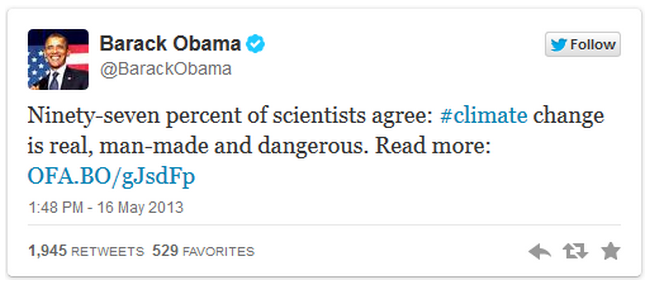
The most recent entrant in the long and checkered history of pious fraud is the exaggerated claim that 97% of climate scientists all agree on climate change. The claim started out as a paper (not peer reviewed, btw) and then went on to get lots of airtime. Even President Obama tweeted it:
There are lots of problems with the original paper and with the way that the paper has been used by others. Before we dig in, however, it’s important to carefully define the terms. The issue that is really at stake is not just a science issue, but a policy issue as well. It has 5 core components. They are:
Climate change is really happening, and will continue to happen. (Implied: human forecasts are accurate.)
The principle cause of climate change is human behavior (e.g. carbon emissions).
The effects of climate change will, on balance, do much more harm than good.
Climate change is largely reversible (e.g. we can do something about it).
The costs of reversing climate change (e.g. with slower economic development for impoverished nations) are outweighed by the benefits.
As it turns out, however, the 97% paper successfully establishes near-universal scientific consensus on exactly none of these issues. Well, maybe on point #1, if you want to be generous. There are several articles out there castigating the authors of the paper for dishonesty and other shenanigans, but by far the strongest evidence of just how fraudulent the paper is comes from Popular Technology.
First, let’s explain how the 97% paper worked. Bjørn Lomborg (as reported in WattsUpWithThat) writes that:
The paper looks at 12,000 papers written in the last 25 years (see here, the paper doesn’t actually specify the numbers, http://notalotofpeopleknowthat.wordpress.com/2013/07/12/watch-the-pea/). It ditches about 8,000 papers because they don’t take a position.
They put people who agree into three different bins — 1.6% that explicitly endorse global warming with numbers, 23% that explicitly endorse global warming without numbers and then 74% that “implicitly endorse” because they’re looking at other issues with global warming that must mean they agree with human-caused global warming.
Voila, you got about 97% (actually here 98%, but because the authors haven’t released the numbers themselves, we have to rely on other quantitative assessments).
In other words, the 97% paper is based on interpreting the papers of various other climate scientists. So what Popular Technology did is actually quite simple, they asked the original authors if they agreed with how the 97% paper had characterized their articles. As it turns out: they did not. The 97% paper effectively drafted many of the most vocal and outspoken critics into the consensus regardless of their actual feelings. That would be bad enough. But, as the scientists described, the problems only get worse from there.
Let’s start with issue #2. Ostensibly, this should be the most reliable claim of the paper because it’s the whole point of the paper. Other folks, like President Obama, may have subsequently added on points 3-5 (which the paper itself didn’t claim), but surely the paper at least had some accuracy about the main issue it claimed to study? Not really. The problem is that the consensus being defended is what’s called the IPCC consensus (after the UN’s Intergovernmental Panel on Climate Change), but the IPCC defined anthropic global warming as global warming that is caused 90%-100% by humans. That’s a pretty high bar. The 97% paper, on the other hand, lowered that bar to just 50% and it did so without explaining what they were doing or why. Dr. Scaffeta, who has a PhD in physics and whose paper was used by the 97% paper as evidence of the consensus, explains:
Cook et al. (2013) [the 97% paper] is based on a strawman argument because it does not correctly define the IPCC AGW theory, which is NOT that human emissions have contributed 50%+ of the global warming since 1900 but that almost 90-100% of the observed global warming was induced by human emission.
What my papers say is that the IPCC view is erroneous because about 40-70% of the global warming observed from 1900 to 2000 was induced by the sun. [emphasis added]
Please note that it is very important to clarify that the AGW advocated by the IPCC has always claimed that 90-100% of the warming observed since 1900 is due to anthropogenic emissions. While critics like me have always claimed that the data would approximately indicate a 50-50 natural-anthropogenic contribution at most. [emphasis added]
What it is observed right now is utter dishonesty by the IPCC advocates. Instead of apologizing and honestly acknowledging that the AGW theory as advocated by the IPCC is wrong because based on climate models that poorly reconstruct the solar signature and do not reproduce the natural oscillations of the climate (AMO, PDO, NAO etc.) and honestly acknowledging that the truth, as it is emerging, is closer to what claimed by IPCC critics like me since 2005, these people are trying to get the credit.
They are gradually engaging into a metamorphosis process to save face.[emphasis added]
This is why I say that none of the 5 points above are actually substantiated by the 97% paper. Not only do Scaffeta (and many more) reject the characterization of their papers, but they in fact have dissenting views about the causes of global warming. This has profound implications. If (to use Scafetta’s high estimate), 70% of the global warming from 1990 – 2000 is caused by the sun, then this means that the models used by the IPCC consensus are wrong and we can’t trust their forecasts (so much for points 1 and 3). It also means that we have significant reason to doubt whether or not there’s much humans can do about climate change (points 4 and 5).
This is far from the only explosive comment to come from these scientists, however. Dr. Nir J. Shaviv (PhD in astrophysics) was also cited as being a part of the 97% consensus, and also completely rejected that categorization. He wrote:
Nope… it [that the paper was part of the 97% consensus] is not an accurate representation. The paper shows that if cosmic rays are included in empirical climate sensitivity analyses, then one finds that different time scales consistently give a low climate sensitiviity. i.e., it supports the idea that cosmic rays affect the climate and that climate sensitivity is low. This means that part of the 20th century should be attributed to the increased solar activity and that 21st century warming under a business as usual scenario should be low (about 1°C).
I couldn’t write these things more explicitly in the paper because of the refereeing, however, you don’t have to be a genius to reach these conclusions from the paper. [emphasis added]
So, not only does he also find that cosmic rays must factor into some of the warming (and therefore also criticize the forecasts), he also points out that he was unable to express his true opinion because of the peer review process, which was basically censoring (albeit not very well) his true belief. Just as a quick summary of the rest of the findings, here are some additional comments from the scientists who spoke with Popular Technology about how they felt the 97% paper characterized their own work:
“It would be incorrect to claim that our paper was an endorsement of CO2-induced global warming.” (Dr. Craig D. Idso, Geography)
“I think your data are a load of crap. Why is that a lie? I really think so.” and “I think your sampling strategy is a load of nonsense. How is that a misrepresentation? Did I falsely describe your sample?” (Dr. S. J. Tol, Economics, in a series of tweets to one of the authors of the 97% paper.) [emphasis original to the Popular Technology article]
“The paper is strongly against AGW, and documents its absence in the sea level observational facts. Also, it invalidates the mode of sea level handling by the IPCC.” (Dr. Nils-Axel Morner, Quaternary Geography, describing how his own paper is actually against the consensus.)
“I am sure that this rating of no position on AGW by CO2 is nowhere accurate nor correct…. I hope my scientific views and conclusions are clear to anyone that will spend time reading our papers. Cook et al. (2013) is not the study to read if you want to find out about what we say and conclude in our own scientific works.” (Dr. Willie Soon, Rocket Science, describing why the categorization of his paper as having “no position” on anthropic global warming was false. He added: “No extra comment on Cook et al. (2013) is necessary as it is not a paper aiming to help anyone understand the science.” [emphasis added])
“If Cook et al’s paper classifies my paper, ‘A Multidisciplinary, Science-Based Approach to the Economics of Climate Change’ as “explicitly endorses AGW but does not quantify or minimize,” nothing could be further from either my intent or the contents of my paper… I would classify my paper in Cook et al’s category (7): Explicit rejection with quantification.” (Dr. Alan Carlin, Economics) [emphasis original to Popular Technology piece]
Where does that leave us? The most charitable possible interpretation is that the 97% paper deliberately or negligently inflated consensus on this issue. The reason for doing this is obvious: it’s a policy paper rather than a scientific paper. It is designed to get people to support policies intended to curb global warming without actually proving that these policies are the right decisions to make. It is a pious fraud. When the paper is used by others who tack on issues 3-5 (harm, reversibility, and net-benefit of opposing global warming) they are compounding the same fraud which the paper was deliberately designed to initiate.
This is a very, very bad idea. It is a bad idea because it poisons the entire debate. If scientists are willing to blatantly lie and fabricate to try and win a policy war, how can we (especially we who are non-experts) trust the scientific “consensus”? If the consensus were as low as 33% of scientists but it was transparent and honest and included all 5 points, that would be enough to make the issue quite serious. If it was as high as 67% (with the same conditions) that would be enough to make me seriously consider supporting drastic policies. But to try and trick people into believing there is consensus on all 5 points when there is, at best, exaggerated consensus on just 1 or 2 points throws the entire policy argument into question. Now I know that people are lying to me, and I also know that I have no realistic way of estimating the extent of the fabrications. I have to weigh the uncertain efficacy and uncertain benefits of climate change remedies against their certain costs.
This is not a good position for someone to be in if they are truly worried about climate change. And it’s not a reasonable position to be in if you’re actually confident of the facts. The fact that we are in this position at all is the reason that I, like many other open-minded skeptics, look for other possible explanations to explain the absolutist rhetoric of the climate change alarmists.
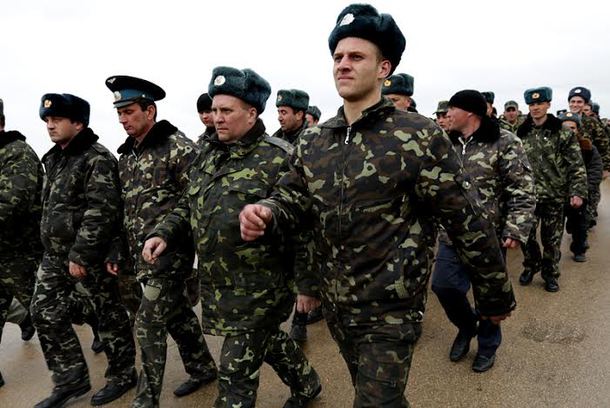
It never occurred to me for a moment that an armed force might consider using *non-violent* resistance, but apparently that’s what the Ukrainian forces in Crimea are doing. Based on alleged communication intercepts, Putin has no idea what to do about it. He sent in thousands of troops with the idea that they would trigger a fight-or-flight response in the Ukrainian army. He wants them to start shooting (and provide justification for a massacre) or surrender. Instead, every single unit so far has refused to do either, and their wives have also demonstrated stunning bravery, standing as human shields between Russian forces and their outnumbered, outgunned, and undersupplied husbands.
If I’m getting this story right, it’s an incredible strategy of courage, nobility, and also genius. But I don’t know how long it can continue.
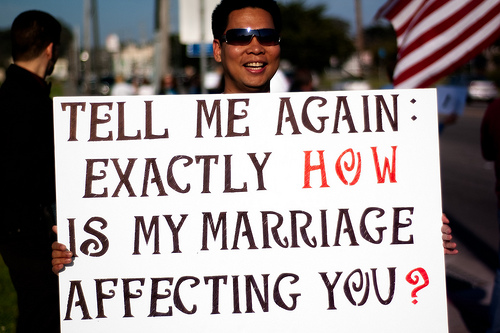
Doublethink is a term from Orwell’s classic novel 1984. It is “the act of ordinary people simultaneously accepting two mutually contradictory beliefs as correct, often in distinct social contexts.” I’ve heard people try to come up with real-world examples of the term, but so far none have really lived up to the original meaning. But I think we’re really standing on the threshold now, and it’s the issue of gay rights that threatens to push us over the edge.
Up until recently, one of the key components of the push for gay rights has been that it would take a “live and let live” philosophy. If you don’t like gay marriage: don’t have one. But obviously gay marriage wouldn’t somehow force religious institutions to change their doctrine or allow their buildings to be used, nor would it require religious people to participate in or condone gay marriages. Right? Well, no. Not really.
This became obvious when Arizona tried to pass a bill that would have enacted the principle that “we should not punish people for practicing their religion unless we have a very good reason.” If that doesn’t sound like what the Arizona bill did, that’s no surprise. According to Professor Doug Laycock, who is one of the foremost experts on law and religion, “Arizona’s Religious Freedom Restoration Act, was been egregiously misrepresented both before and after the veto.” You should really read his explanation of what the law really did, but the gist of it is simple: Rather than legalize anti-gay discrimination, the law would have simply clarified the context in which these types of cases would be viewed by the courts, who would still be open to determining who won or lost in any given case.
Instead, however, the country was fed the impression that Arizona wanted to legalize anti-gay discrimination. Which would be wrong, right? If a gay couple walks into your bakery and orders a wedding cake, you bake them the cake. Or else.
I think it’s just equality, dignity for everyone. I think everybody should be allowed the right to be together.
In other words, he had a sincere moral conviction and it would violate that moral conviction to force him to use his business, his talents, and literally his body to support someone who was opposed to that moral conviction. Sound familiar?
Ross Douthat pointed out that the no-holds-barred takedown of the Arizona bill was unprecedented, and he understands what that signifies:
What makes this response particularly instructive is that such bills have been seen, in the past, as a way for religious conservatives to negotiate surrender — to accept same-sex marriage’s inevitability while carving out protections for dissent. But now, apparently, the official line is that you bigots don’t get to negotiate anymore.
So this is where we stand today. Either the American people realize that treating religious objections to participation in gay marriage is a legitimate concern (perhaps with the help of examples like those above) and adopt a more nuanced pose. Or, on the other hand, they ignore the examples and press forward. In that brave new world, I fully expect that the right of gay people to refuse service to religious bigots will be enshrined legally, but the right of religious people to refuse to participate in gay weddings will be scorned and derided. And then, ladies and gentlemen, we will have arrived at a real-life example of doublethink in the wild.
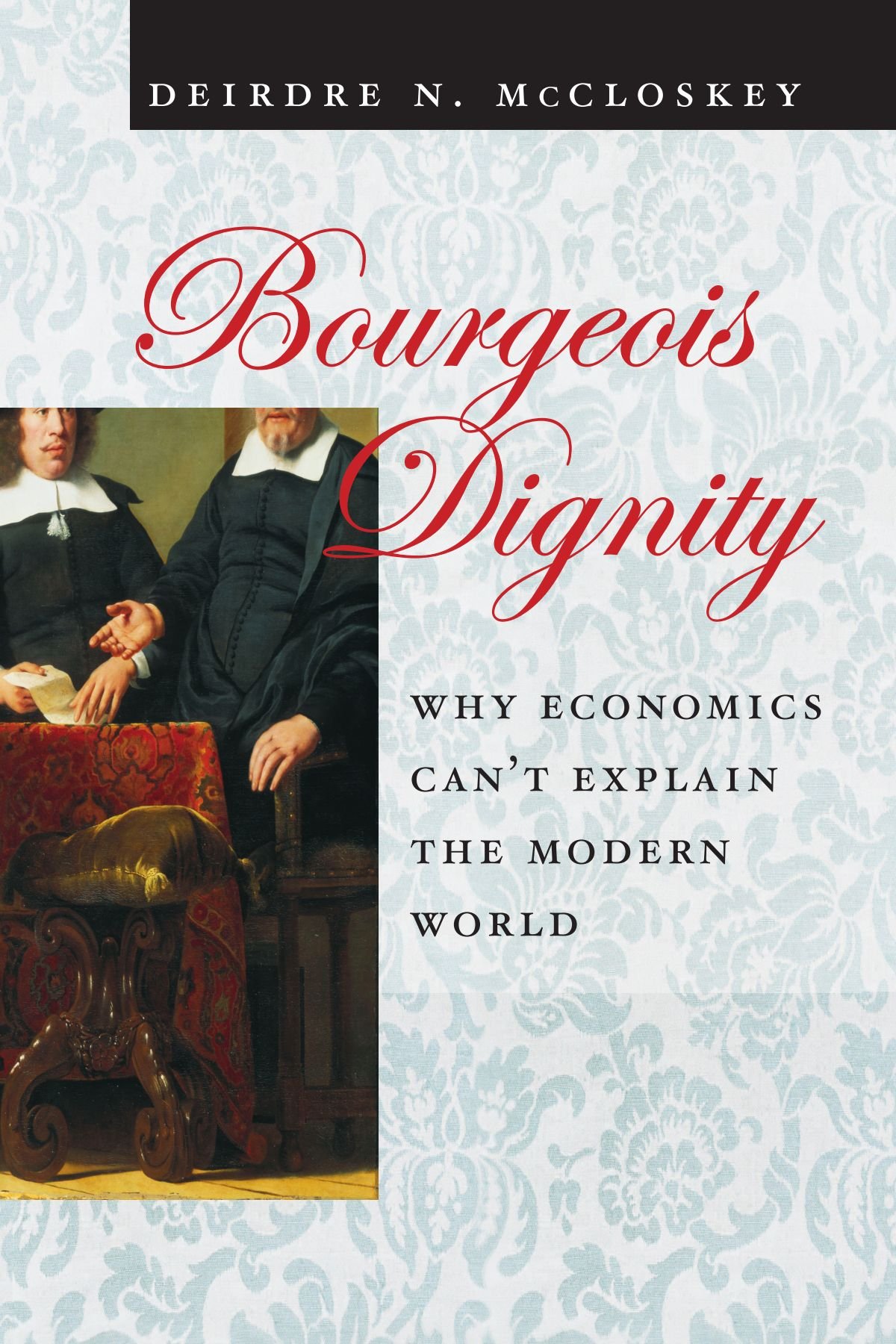
Economist Deirdre McCloskey presented a paper entitled “The Great Enrichment Came and Comes From Ethics and Rhetoric” at a New Delhi conference for the Centre for Civil Society in January. The following excerpt is, in large part, why I support markets:
Free markets, that is, have not been bad for the poor of the world. The sole reliable good for the poor, on the contrary, has been the liberating and the honoring of market-tested improvement and supply. Private charity and public works, socialism and central planning, by contrast, have often made people worse off. Yet economic growth since 1800 has almost always made them better off, by enormous factors of increase. The enrichment of the poor, that is, has not come from charity or planning or protection or regulation or trade unions, all of which, despite their undoubted first-act popularity among our good friends on the left, merely redistribute a constant or a shrunken pie. The mere arithmetic shows why. If all profits in the American economy were forthwith handed over to the workers, the workers (including some amazingly highly paid “workers,” such as sports and singing stars and big-company CEOs) would be 20 percent or so better off, right now. One time only. The 20 percent is to be compared with a rise in real wages 1800 to the present by a factor of 10 or 30 or (allowing for improved quality of goods) 100, which is to say 900 or 2,900 or 9,900 percent. If we want to make the non-bosses or the poor better off by a significant amount, 9,900 percent beats 20 percent every time. At 5 percent per year market-tested improvement and supply goes beyond the one-time 20 percent in a scant four years, and then cumulates to a quadrupling.
Check it out. The third volume of her trilogy on the Bourgeois Era- (the 2nd of which is pictured above)-The Treasured Bourgeoisie: How Markets and Innovation Became Virtuous, 1600-1848, and Then Suspect–will be out in 2015.
Back in 2011, I graduated from the University of North Texas with a BBA in Organizational Behavior & Human Resource Management. My excitement over it was lackluster to say the least. I rarely mentioned my upcoming graduation in the months prior. My own sister hadn’t even been aware I was graduating until afterwards (much to her irritation). I wrote my thoughts about my business education over at The Slow Hunch, noting its pros and cons:
While it may be true that businessmen and economists alike are not as accustomed with philosophy, ethics, or literature as they should be, this does not by default mean that the philosophers opining on the state of the economy have any justification for doing so. Business majors may need to crack open the work of Aristotle, but liberal arts majors would do well to be acquainted with Economics 101. Why? Because one advantage of business education is the focus on practical application, even in management. Theory is important, but whether it actually works is critical.
I didn’t stop with just business majors, but instead commented on the state of higher education as a whole:
The critiques of business education are valid. However, before the [insert liberal arts degree] majors begin their victory dance or crowing about their more nuanced understanding of the world…it should be pointed out that this decline in business major standards is fairly typical across the board. I often quip that the bachelor degree is the new high school diploma. Given the grade inflation that has taken place over the past several decades, I think it is fair to say that higher education as a whole has suffered. Economist Richard Vedder has found that “some 17,000,000 Americans with college degrees are doing jobs that the [Bureau of Labor Statistics] says require less than the skill levels associated with a bachelor’s degree.” With tuition increasing, Vedder has no problem labeling the push for more college graduates a scam. Vedder explains, “Employers are using education as a screening and signaling device, at a low cost directly to them (although not costless because of the taxes they pay to sustain much of this), but at a high cost to the prospective employees and to society as a whole.” Apparently, another type of bubble has popped: higher education.
A new report from the Lumina Foundation and Gallup fuels my pessimism:
Seven in 10 leaders say they would consider hiring someone without a degree or credential over someone with one.
Just 13% of business leaders say higher education institutions collaborate with business a great deal.
Most leaders (88%) favor an increased level of collaboration with higher education institutions.
About one in ten business leaders strongly agree that higher education institutions in this country are graduating students with the skills and competencies their business needs.
Just (14%) of executives say they are very likely to hire a candidate who has a degree from an online higher education over a candidate with a traditional higher education.
Business leaders were most likely to indicate the amount of knowledge a candidate has in the field is a very important factor to managers making hiring decisions for organizations.
For business leaders, work skills top the list of factors that should drive immigration policy decisions.[ref]”What America Needs to Know About Higher Education Redesign,” pg. 23[/ref]
There is a disconnect between what business leaders need and what higher education institutions think they are producing. A separate Gallup study for Inside Higher Ed finds that 96% of chief academic officers at higher education institutions say their institution is very or somewhat effective at preparing students for the world of work. Quite the reverse, business leaders say that college graduates do not have the skills that their particular businesses need such as applicable knowledge and applied skills in the field. Even though leaders are not yet turning to foreign-born workers when hiring, they favor increasing green card policies for foreign-born international graduate students in the U.S.
This is likely why “a strong majority of business leaders favoring an increased level of collaboration between higher education institutions and businesses. An increased level of collaboration will benefit both business leaders and higher education institutions in preparing students with the right knowledge and applied skills so that they are ready for the real world and have the best opportunity to find a good job.”
While we may be complacent in thinking the shiny degree hanging on the wall means we’re educated and highly-skilled, business leaders are providing a much-needed wake up call. It’s not about the piece of paper, but what you can actually do. In the immortal words of Alec Baldwin in Glengarry Glen Ross, “You wanna work here — close.”