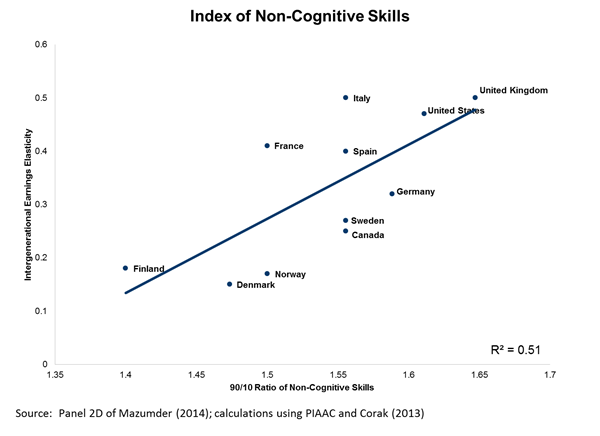
A recent publication by the Chicago Fed looks at skill gaps in numeracy, literacy, problem-solving, and non-cognitive skills and their relation to income mobility. Perhaps surprisingly (perhaps not), the author found
that inequality in an index of “non-cognitive skills” explains as much or more of the variation in intergenerational mobility than inequality in traditional measures of cognitive skills such as numeracy, literacy, and problem solving. An emerging line of research has argued that personality traits such as perseverance and grit play an important role in socioeconomic success. These results are consistent with the idea that the large gaps in skills in the U.S. population are part of what is driving both higher inequality and lower intergenerational mobility.
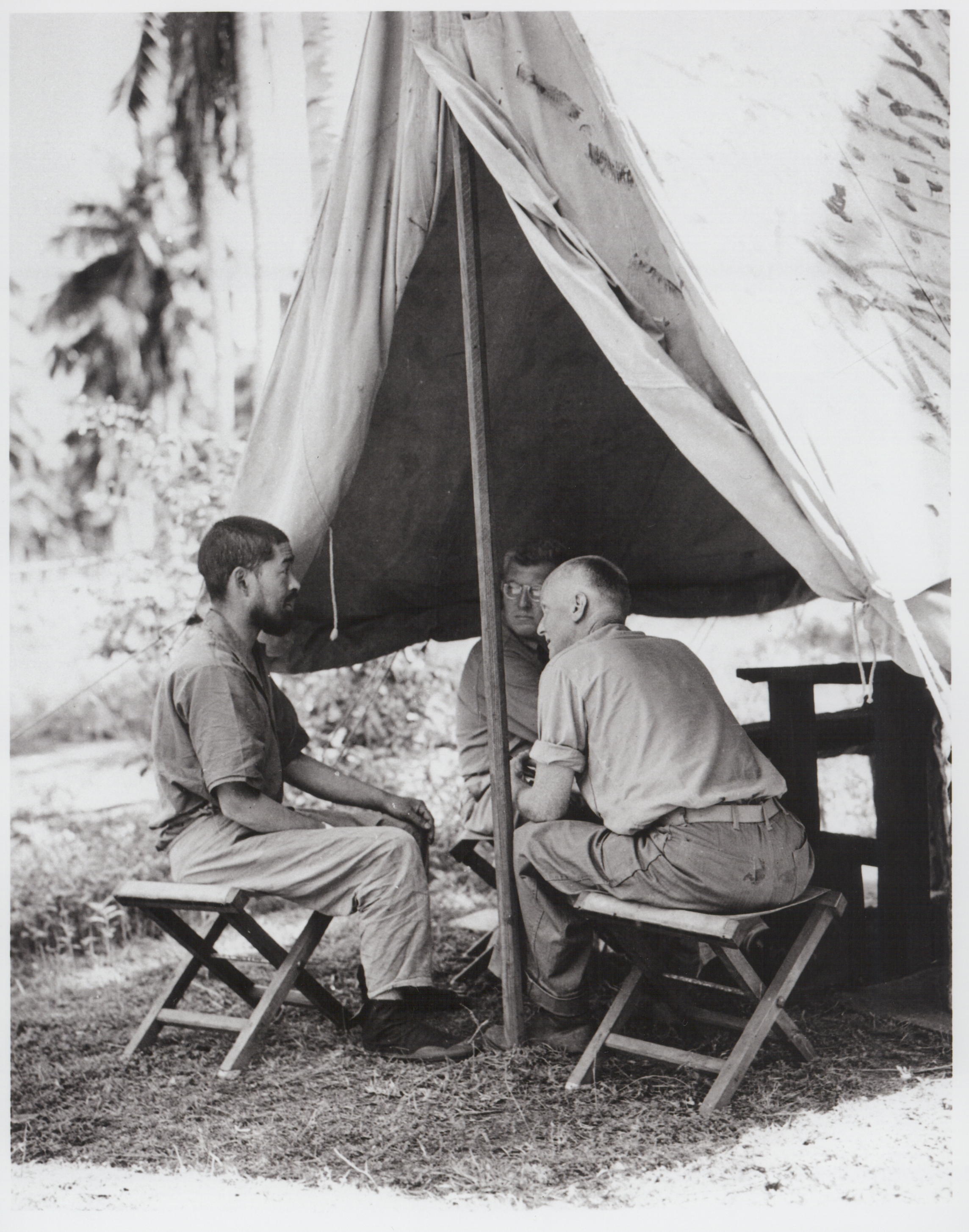
Intelligence agencies are not filled with moral philosophers by any means. Cheating and deception kind of go with the territory. The recent report on the CIA’s use of terror has raised two questions. First, is torture moral. Second, is torture effective. The first question is very easy to answer. Torture is not moral. The second question, to my mind, has more far-reaching implications. Basically, if torture is not effective, then one has cruelly abused another human being for nothing. It can be defended neither on moral grounds, nor on those derived from expediency. If a deed is ugly but must be done, that is one thing. If it is ugly and pointless, then it is completely reprehensible. Ultimately, the goal of an interrogation is to gain correct and useful information. This might seem counterintuitive when dealing with terrorists, but treating the person under interrogation softly and kindly will actually lead to better results than anything extracted by torture. There is an interesting article on two of the most successful interrogators of the Second World War. Hans Joachim Scharff and Sherwood Ford Moran came from different backgrounds, were on different sides, and faced different conditions for interrogation. Neither ever resorted to torture or other forms of coercion. Scharff created an easy-going atmosphere for captured aviators when they were expecting to be brutally tortured. Scharff cared for his prisoners’ well-being, and upheld an illusion of knowing everything, so none of his prisoners thought that they had given away important information even when they had. Moran, too, genuinely cared for the well-being of his Japanese prisoners. If they were hungry, they got fed well. If they were wounded, they got good medical treatment. Because of this, they saw Moran as someone who cared, rather than a personal enemy Moran needed to be direct with his questions because he was on the front lines, but having lived in Japan as a missionary, he knew Japan and the Japanese intimately. When he couldn’t make a prisoner relax enough to talk, he would use the Japanese concept of honor to make the prisoner feel ashamed for his behavior. Both Scharff and Moran were able to piece together the big picture out of seemingly small, inconsequential details. Modern interrogators will face different circumstances, but employing a similar approach they can get good results without the need for torture. Treat your prisoners as human beings, understand their culture and language, and get them talking. Simple enough, really.
Learning from history what works—and what does not—can make a world of difference in terms of future interrogation practices.
A friend of mine from Moscow has been posting for several days about a cool event scheduled for December 11th. The Eye of Sauron was going to appear on a tower in the Moscow-City business center. It would have been huge, and very prominent. Well, Svecheniye- the art group behind the project- have just announced that they are scrapping the whole thing. They stated that there was nothing political or religious about their Eye of Sauron project, but they received intensely adverse reactions. While the Russian article I read did not specify who pressured Svecheniye, it seemed pretty obvious. Several news articles have been more explicit. The Russian Orthodox Church strenuously objected to prominently displaying a “demonic symbol of the triumph of evil” in Moscow because it would bring disasters upon the city. For the Russian Orthodox Church, Moscow is a profoundly holy city, the Third Rome. As an Estonian scholar noted, it is crucial to that church’s self-identity.
Moscow is not only the most important city but it is chosen by God and in a way set apart from other places on the earth. Moscow has a special religious function. It is the Christian centre. It is in some way closer to God. But that is not all… Moscow is the Third Rome and “the third stands, and there will never be a fourth.“ Moscow is the last Rome. Moscow was the centre of history and therefore its fulfilment. This means that Russia had to preserve its rich store of faith in purity in the last phase before the end of the world. And this fact puts a heavy responsibility on the shoulders of the Russians.
With this kind of metaphysics, the Tolkien fans never stood a chance. Never mind that Sauron symbolizes the hubris and ultimate futility of evil, not its triumph. The political power of the Russian Orthodox Church means that it can win these battles quite easily.
Hypersensitivity is a pernicious way to win a debate: if you can brand an argument as offensive/harmful, then you never have to respond it. Trolling is a destructive response to that tactic: provoking more and more outrage undermines the credibility of your opponent. These are, I think, the twin central dysfunctions of political debate today, and that’s what I decided to write about for Times and Seasons this morning.
I’ve relied on economist Mark Perry before regarding inequality and demographics. Not much has changed since last year. As Perry summarizes,
Specifically, high-income households have a greater average number of income-earners than households in lower-income quintiles, and individuals in high income households are far more likely than individuals in low-income households to be well-educated, married, working full-time, and in their prime earning years. In contrast, individuals in lower-income households are far more likely than their counterparts in higher-income households to be less-educated, working part-time, either very young (under 35 years) or very old (over 65 years), and living in single-parent households.
The good news is that the key demographic factors that explain differences in household income are not fixed over our lifetimes and are largely under our control (e.g. staying in school and graduating, getting and staying married, etc.), which means that individuals and households are not destined to remain in a single income quintile forever. Fortunately, studies that track people over time indicate that individuals and households move up and down the income quintiles over their lifetimes, as the key demographic variables highlighted above change…
See Perry’s post for a more in-depth look at the numbers.
Believe it or not, I am not the one irritating anyone this time. Nope, it’s Damon Linker, who is himself a social liberal. But he frustrated his compatriots with a recent article about moral libertarianism. Linker traced the origins of moral libertarianism to Supreme Court Justice Anthony Kennedy claim, in Planned Parenthood v. Casey, that “At the heart of liberty is the right to define one’s own concept of existence, of meaning, of the universe, of the mystery of human life.” As Linker writes:
Justice Antonin Scalia recognized immediately that such a libertarian principle created serious problems for morals legislation of any kind. In his Casey dissent, he pointed out that the principle would seem to make laws against bigamy unconstitutional.
Scalia has been proved right again and again as morality-based laws have fallen beneath the scythe of Kennedy’s moral libertarianism which boils down to one simple precept: if it’s not hurting anyone then it should be legal. Sound familiar? It should. Because it’s becoming the dominant moral-legal view of our entire society, which is Linker’s whole point. And then Linker did the truly unthinkable: he suggested that this brave new future of maximal moral permissiveness might not be 100% good. That’s where he angered his fellow social liberals, and it prompted today’s article: No, I’m not the Rick Santorum of punditry.[ref]Hence the pic above, which comes from this article.[/ref]
To his credit, Linker doesn’t back down.
As social psychologist Jonathan Haidt has shown (and as I’ve written about before), liberals tend to focus on two aspects of moral experience: care for and avoidance of harm toward others, and a concern for egalitarian fairness and hostility to cheating. As for more hierarchical or aspirational moral ideals — loyalty/betrayal, authority/subversion, and sanctity/degradation — those matter much less to liberals. Conservatives, by contrast, express concern about all five moral categories, with religiously oriented conservatives placing special emphasis on striving for moral sanctity or purity.[ref]Haidt has revised his theory to include 6 foundations, but the basic observation is correct.[/ref]
When I write about our moral qualms (or rather, our increasing lack of moral qualms) about homosexuality, polyandry, porn, consensual brother-sister incest, and bestiality, I’m focusing on a dimension of morality that liberals are both relatively uninterested in and often positively uncomfortable with… I sound an awful lot like a conservative… But the suspicion that I’m covertly on the religious right’s payroll goes beyond my mere discussion of such topics… I may strive for a dispassionate tone in my writing about moral trends, but it’s possible to detect a degree of discomfort as well. When I ask what my readers would do if their daughters began to work in porn, or raise the question of whether there are any legal grounds for outlawing consensual brother-sister incest, or wonder if it’s okay for a human being to engage in sexual relations with a horse, I sometimes sound troubled, disturbed, agitated.
Am I?
Yes. And you know what else? I suspect that many liberals are, too, though they’re loathe to admit it in public, and perhaps, in many cases, even to themselves.
It’s great that an outspoken liberal like Linker is willing to point this out. But it’s also sad that he’s one of the very few willing to do so, and will be largely ignored. That’s true despite the fact that, like Linker, I believe that “many liberals” privately share his concerns. But, unlike Linker, they have neither the inclination nor the shield to be willing to speak up about their concerns.[ref]When you write a book like The Theocons: Secular America Under Siege you buy yourself some wiggle room.[/ref] So: good for Linker. But my applause is significantly dampened by the ominously rigid ideological conformity on such an important issue. When everyone knows something is wrong and almost no one is brave enough to say so, you start to see the real power of the New Intolerance.
Earlier this year, The Spectator ran a great article contrasting the worldviews of French economist Thomas Piketty and Chicago-style economist Deirdre McCloskey. “Piketty (for those who have not followed the story so far) worries about capital and, in particular, the tendency for those who already have it to get more,” the article proclaims. “…McCloskey, by contrast, has long argued that economists are far too preoccupied by capital and saving…Th[e] jump in incomes [in the 19th century] came about not through thrift, she says, but through a shift to liberal bourgeois values that put an emphasis on the business of innovation. In place of capitalism, she talks of ‘market-tested innovation and supply’ as the active ingredient of our economic system. It is incidentally a system ‘drenched’ in values and ethics overlooked by economists.” And it is this that gets to the heart of the matter: “whether capital — past accumulation of savings — gets to devour the future, or whether the future is created afresh by each generation. This argument is a struggle between those who think riches are created from riches, and those who think riches are created from rags. Are big profits best viewed as a generous return on capital, in the way that worries Piketty? Or as coming from innovation that ultimately benefits us all?”
Well, McCloskey now has a full response to Piketty’s Capital in the Twenty-First Century forthcoming in the Erasmus Journal of Philosophy and Economics and available on her website. The title? “Measured, Unmeasured, Mismeasured, and Unjustified Pessimism: A Review Essay of Thomas Piketty’s Capital in the Twenty-First Century.” From demonstrating Piketty’s misunderstanding of supply and demand curves (“He is in short not qualified to sneer at self-regulated markets…because he has no idea how they work”) to noting the strange obsession with inequality (“…and [apparently] we care ethically only about the Gini coefficient, not the condition of the working class”), McCloskey does a fine job in her 50 pages painting a very different picture of the world. However, my favorite portion has to be the following:
Righteous, if inexpensive, indignation inspired by survivor’s guilt about alleged “victims” of something called “capitalism,” and envious anger at the silly consumption by the rich, do not invariably yield betterment for the poor. Remarks such as “there are still poor people” or “some people have more power than others,” though claiming the moral high-ground for the speaker, are not deep or clever. Repeating them, or nodding wisely at their repetition, or buying Piketty’s book to display on your coffee table, does not make you a good person. You are a good person if you actually help the poor. Open a business. Arrange mortgages that poor people can afford. Invent a new battery. Vote for better schools. Adopt a Pakistani orphan. Volunteer to feed people at Grace Church on Saturday mornings. Argue for a minimum income and against a minimum wage. The offering of faux, counterproductive policies that in their actual effects reduce opportunities for employment, or the making of indignant declarations to your husband after finishing the Sunday New York Times Magazine, does not actually help the poor (pg. 34).
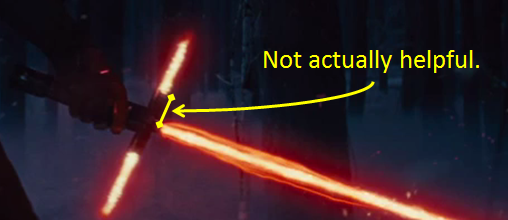
I am not a fan of the Star Wars: The Force Awakens teaser. It was so bad that I didn’t believe it was the real trailer at first. Alas, it is. Of all the things that annoyed me, however, there is one that stuck out the most: the absolutely useless and silly design of the crossguard for the lightsaber.
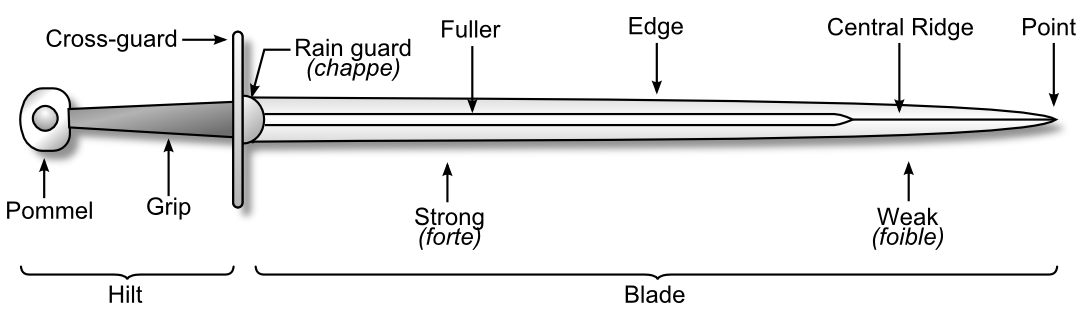
The purpose of a crossguard is simple: to protect the hand of the person using the sword (or, in this case, lightsaber).
In order to be effective, the crossguard therefore has to be tough enough to stop an opponent’s blade. In an ordinary sword (made of metal), you just accomplish this by also making the crossguard out of metal. Simple. But the entire point of a lightsaber is that the blade cuts through just about anything. So the only thing that you could possibly make a crossguard out of would be the actual light blade. Anything else is just going to get lopped off instantly, offering absolutely zero protection. This can actually be done. If you look at the entry for crossguard light sabers in the Wookieepedia[ref]Yes, there’s a Wookieepedia, and yes, it has an entry for crossguard lightsabers.[/ref]you can see how it’s been pulled off in the past.
Notice how the crossguard in that image is recessed so that a strike of an opponent’s blade that slid along the user’s blade would be intercepted by the blade of the crossguard. Not by the vulnerable housing for the crossguard blade. But in the crossguard lightsaber from the trailer, the blades of the crossguards are offset from the grip.This makes the crossguards about as useful as if a Viking went into battle with a crossguard make out of tissue paper.
The whole idea of a lightsaber crossguard is a little dumb to begin with because what makes lightsabers awesome is their elegant simplicity.[ref]”An elegant weapon for a more civilized age.” – Obi-Wan Kenobi, A New Hope[/ref] Double blades, intricate handles, all these additions detract from that simplicity and elegance. But if you’re going to put on a crossguard, at least think about it for 5 seconds and don’t make something that looks like a 7-year old glued the pieces together.
Look, I get that Star Wars isn’t exactly supremely realistic, not even when it comes to lightsabers and their practical utility.
The Ewoks were always kind of dumb, even when I was a kid, and the idea of individual pilots zooming around in space fighters exactly as if it were a World War 2 era dogfight was outdated by the technology of the Korean War (jet engines and guided missiles), let along by the time we’ve got FTL spaceships. The originals had flaws, but they were still great. The prequels were so egregiously horrible as to be nigh unwatcheable.[ref]Brief personal Star Wars history: I loved the originals so much that I waited overnight in line to be #5 to get tickets for Phantom Menace. I won Star Wars trivial pursuit in that line, with those super-fans. I watched it six times, willing it to be good. It wasn’t. I never watched Episode II all the way through, and I watched Episode III just once, for old time’s sake. I also read several of the tie-in novels, but they all suck except for the ones by Timothy Zahn. The Clone Wars series is pretty good, and I’ve read a couple of comic books that were OK.[/ref]
We’ve all got to draw our own lines for what fits the spirit of the films, and what doesn’t. For which unrealistic detail is just part of the show, and for which is a violation of artistic integrity. The dumb crossguards cross a line of basic common sense for me. Even if my wife thinks I’m crazy and obsessive. But I’m not ruling out the new movie based on just a teaser. In the final product the good could very well outweigh the bad, and like I said, the originals had some pretty glaring flaws of their own. [ref]”But I was going into Tosche Station to pick up some power converters!”[/ref] But between the dumb crossguard and all the other issues with the trailer[ref]The narrator’s voice sounds like a parody, for starters.[/ref], my hopes for the franchise’s attempted resurrection are not getting any higher.
Not long ago I was asked to participate in a new initiative at Meridian Magazine: creating a new section (called “Expand”)[ref]First as a writer, and then as a contributing editor.[/ref] The site launched about two weeks ago with a mission statement from Ralph Hancock, who is leading the project. The image above gives a pretty succinct distillation of what Expand hopes to do: provide a space for Mormon thinkers to host “civil discussion that engages the great moral questions, ideological movements, and contending intellectual frameworks of our day.”
Earlier today the fourth article was posted, and this is one that I wrote: Maybe the Prophets Know What They’re Doing. In it, I manage to dredge up most of the controversies and conundrums to hit the Bloggernaccle over the past couple of years. Except Mitt Romney. I didn’t mention him. But other than that, it’s probably in this article.
I don’t know how frequently I’ll be contributing posts there, but there are already lots more great articles in the pipeline, and I’m excited to see how the project grows and develops over time.[ref]I could have said “expand,” but come on. Too easy.[/ref] I hope you’ll all check it out.
I got about half way through this article about the fastest way to board airplanes when I read this line:
The same optimization routine that can solve the traveling salesman problem can be applied to airplane boarding. Drawing from its results, I’ve proposed an optimum boarding method. In this approach, often called the Steffen method…
My first thought when I read this was, “The author of this article better not be named Steffen.” He is. My second thought was to point out the passage to my wife, and say, “Please never do that when you’ve got your PhD.” She just groaned and rolled her eyes. Trying to get people to accept a theory or a method based on your own name is the academic equivalent of trying to give yourself a nickname. Not only will it not help matters, it’s just not done. If the method or the theory is awesome, it will be named after you. Maybe. That will actually depend on whether or not you have cadres of extremely loyal grad students and/or other ardent supporters not yourself who will go promulgate the name on your behalf. Most importantly, however, if the method or theory isn’t awesome, it’s not going to be named after you or anyone else. And this theory isn’t that awesome.
In field tests, this method has outperformed all others. In a test with 72 passengers it was nearly twice as fast as boarding back-to-front or in rotating blocks of rows, methods commonly used in the industry. It was 20 to 30 percent faster than more-optimized boarding methods such as random boarding, when people get on without regard to where their assigned seats are. It also beat boarding windows-middle-aisle. My method even outperformed the industry gold standard of open seating, used by Southwest airlines. That’s when passengers don’t have assigned seats at all.
Steffen’s Method, Illustrated by Steffen.
First, if Steffen says his method outperformed Southwest’s method (no assigned seats) but doesn’t provide a number, I’d guess it was by less than 20%.[ref]I can’t be sure, because the article he cites costs $40 to read. Which sort of negates the purpose of a citation in a popular media article. I found a free version, but it’s older and doesn’t include a comparison with Southwest.[/ref] So you get an improvement of 20% (or less) in exchange for a boarding pattern that looks like the image to the right. The thing to notice there is that the first person who is seated (bottom right, which corresponds to the rear right of the airplane) boards 24 spaces ahead of the person they are sitting next to.
Think about the way people travel. When it’s in pairs or groups, they like to sit together. In order for this to work, you would have to line up with 24 people (or more, depending on the size of the plane) between you and the person you’re traveling with. If it’s your spouse and you want to be together, that’s a mild annoyance. If it’s a child or someone who needs even a little bit of help, that’s a pretty serious issue. And even if it’s another adult, there are still going to be all kinds of problems with who-carries-what. Not to mention people will game the system so that the person who goes first is going to be the one who carries all the carry-ons to get them stowed.
All methods have drawbacks, and I’m sure Steffen’s method probably isn’t worse, in aggregate, than other methods. But, in my humble opinion, that inconvenience of breaking up parties of travelers (in addition to the headache of keeping your passengers in exact order) probably outweigh the 20%-or-less time benefits.




 you buy yourself some wiggle room.[/ref] So: good for Linker. But my applause is significantly dampened by the ominously rigid ideological conformity on such an important issue. When everyone knows something is wrong and almost no one is brave enough to say so, you start to see the real power of the New Intolerance.




 .[ref]Terryl Givens is my father.[/ref]